
A housing company board built itself a supervisory app and a maintenance log in an afternoon
How the board of As Oy Helsingin Rafael used AI to build its own app
on the building's data, without replacing the automation system
As Oy Helsingin Rafael • Housing company
As Oy Helsingin Rafael is a 23-apartment housing company in Helsinki, completed in 2014. Its board wanted to know what was happening in the building without anyone having to watch the systems all the time.
The building was connected to Nobody Engineering's independent data layer. The board then used AI to build its own supervisory app and maintenance log. Now the state of the building, its alarms and the maintenance work are all in one app.
Case summary
Property
23-apartment housing company in Helsinki, completed in 2014
Existing system
Niagara controller, 5,108 automation points
Installation
Edge device plugged into the automation cabinet, the rest done remotely
Built by
A board member with Claude and Nobody MCP, without writing code
Result
Existing automation kept instead of a €16,000+ renewal
Where they started
Rafael's automation system collected a huge amount of data about the building, but in practice it was hard to get at. Alarms went through the service provider's monitoring center and could reach maintenance weeks later.
Once the ventilation stood still for a couple of days before the board noticed the indoor air had gone stuffy. Everything else the system collected could only be viewed with an old Java program that ran on just one kind of computer.
The property manager sent a quote of more than €16,000 for renewing the automation system. Renewing the automation system in a building that was only built in 2014 seemed off, so the board decided to try a different approach. The solution they found with Nobody Engineering now allows them to keep running their healthy automation system.
The supervisory app: the building at a glance
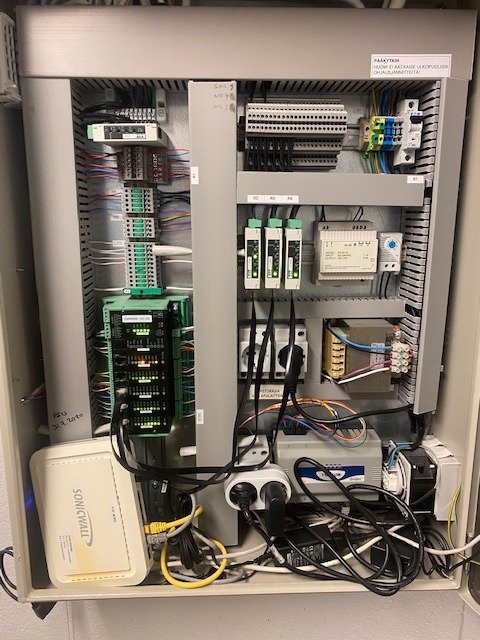
The maintenance technician plugged Nobody's edge device into the automation cabinet, and the rest was done remotely. No existing equipment had to be replaced.
All 5,108 automation points of the building's Niagara controller became readable through one API. The data had been the housing company's own all along, but in practice it was locked inside the service provider's system.
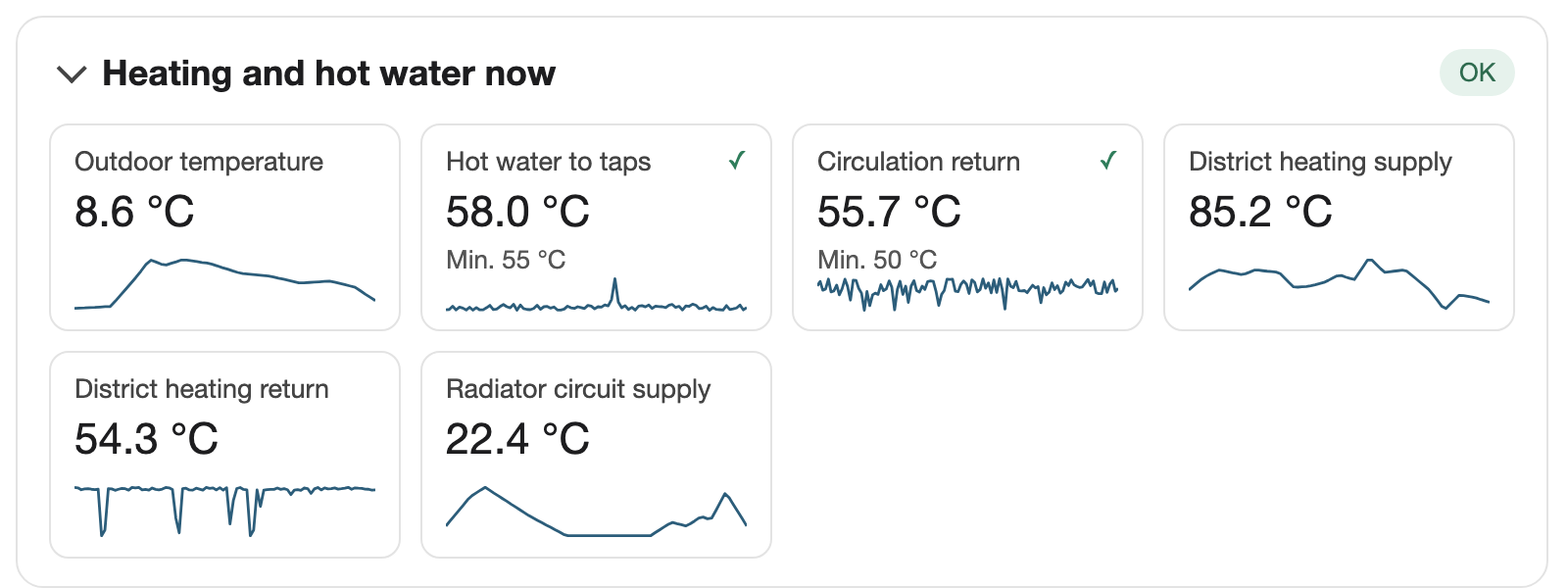
- Apartment temperatures. The board and maintenance see right away if an apartment is too warm or too cold. Per-apartment data is visible only to users entitled to it.
- What's behind the heating bill. Helen sets the district heating basic fee from the return-water temperature during the heating season. The supervisory app shows monthly return-water temperatures and Helen's 40 °C limit in the same chart. Rafael has stayed under the limit every winter. The same view shows heating costs: €14,255 in 2024 and €12,301 in 2025 (excluding VAT).
- Electricity in the same view. Electricity consumption is fetched from Datahub and shown alongside the district heating and automation data.
- Months of measurement history. The app stores the history of the measurements it uses. When the board raised the heating curve, the effect on apartment temperatures could be followed for weeks.
The maintenance log: alarms become concrete next steps
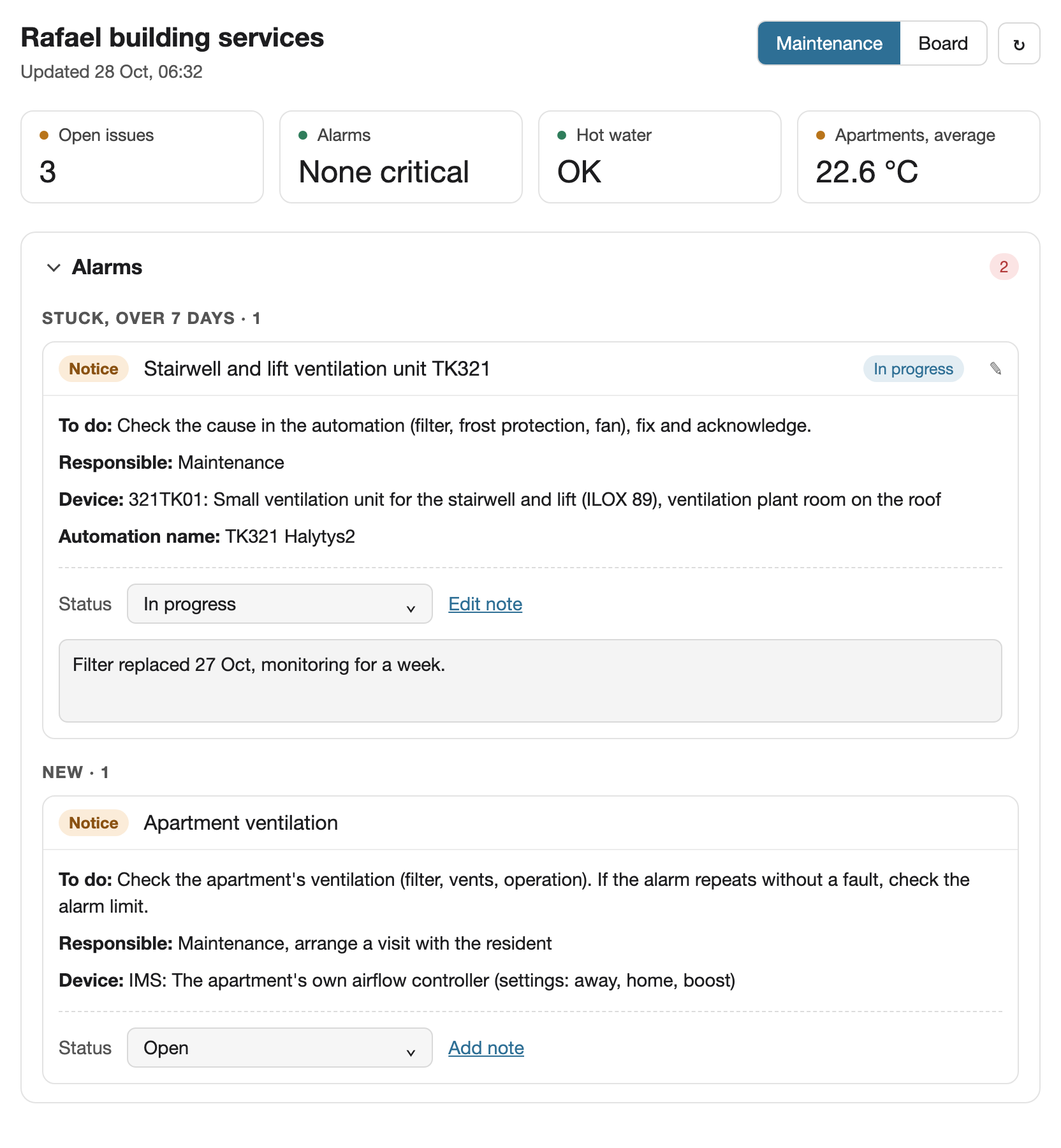
Instead of bare error codes, the maintenance technician sees clear tasks. Every open issue says, in plain language, what needs to be done, who is responsible and which device it concerns.
For example, the alarm "TK321 Halytys2" means the small ventilation unit serving the stairwell and lift, in the rooftop ventilation machine room. The instruction is clear: check the filter, frost protection and fan, make the necessary repairs and mark the task done.
- Most important first. Critical tasks are at the top of the list, then issues open for more than a week, and finally new tasks. Once a problem is fixed, it drops off the list automatically.
- Status and notes. Each task can be given a status, such as "in progress", "waiting for parts", "waiting for a contractor" or "repair ordered". Notes can be added to tasks as well.
- One shared view. When the maintenance technician updates a task, the board sees the change right away, and vice versa. Everyone uses the app with their own account.
Messages directly from the building
An app can only help when someone opens it, but Rafael also gets scheduled messages from Claude.
- To maintenance on Mondays and Fridays. A few lines: what's new, what has been stuck for more than a week, and which apartments are too warm or too cold. Monday's message covers the weekend, and Friday's comes before it. Every item links straight to the maintenance log.
- To the board once a month. Last month's heating cost and return water compared with the previous year, plus open issues.
- A warning in freezing weather. If return water approaches Helen's 40 °C limit, the board hears about it before an overshoot raises next year's basic fee.
The messages aren't alarms but short summaries you can read in a minute. The board decides what goes in them: it tells Claude in its own words what it wants to know.
How it was built
Board member Tuomas Ojanperä isn't a software developer by profession. He connected his own Claude to the building's data with Nobody MCP and asked the AI to build an app for the building.
Nobody MCP (Model Context Protocol) is part of Nobody Works, Nobody's AI toolkit. It gives AI access to building data. Nobody Works also includes an app publishing platform and semantic modelling tools that help turn the technical data of automation systems into something understandable.
The first version came together quickly, and Tuomas has kept developing the app since. In the next phase, Tuomas will work with the technicians to adapt the app to their needs.
Building apps with AI is easy these days, and often fun. The harder part starts when the app goes live. Someone has to take care of its maintenance, security and access rights. With a housing company's data the requirements are especially strict. That's why many promising experiments end up running only on their maker's own computer.
Rafael didn't have that problem. Tuomas could publish the app on the Nobody Works publishing platform, straight into Nobody's environment where the building's data already lives.
Users sign in to the app with their Nobody account and multi-factor authentication (MFA). Each user sees only the buildings they have access to. The board didn't have to get or maintain a server, or build its own login system.
Once the app is finished, it no longer needs AI to work. It's an ordinary web app that uses Nobody's APIs and can be used via its front-end for everyday tasks.
"I didn't have much time for prompting. I made it pretty much in one go."
Tuomas Ojanperä • Board member, As Oy Helsingin Rafael
The board's chair, Mikko Hyytiäinen, who works in IT, is now also building his own tools on the same data.
"These systems have always been a bit of a black box to me."
Mikko Hyytiäinen • Chair of the board, As Oy Helsingin Rafael
Final thoughts
Building software for buildings has become cheaper. Rafael's board made itself a supervisory app and a maintenance log without programming skills and without a new automation system.
Getting into a building's systems, however, hasn't become equally easy. It still takes a connection to the automation system, permission to use its data, and an understanding of what thousands of automation points mean.
That's why Nobody Engineering is building an independent data layer for building services. It makes building data usable without replacing systems that work. Nobody Works, in turn, gives people and AI the tools to use that data.
The housing company decides for itself what is done with its data. It can build its own apps, use other providers' services, or switch between them without having to rebuild the connection to the building's systems.
We connect the building. After that, the people who know it best decide what is done with its data.
If your building knows more than you can see, let's talk.

Ville Ilkkala, Founder, CPO
ville@nobody.engineering
All rights reserved. Contact us at contact@nobody.engineering